
Let’s take a quick minute to talk about buttermilk.
What is buttermilk? Buttermilk is a slightly sour milk. The sourness of buttermilk comes acids in the milk, most notably, lactic acids. Because the proteins in buttermilk are slightly curdled, buttermilk is slightly thicker than regular milk, but not quite as thick as cream. Buttermilk is also usually much lower in fat than regular milk and cream.
Say you wanted to make some butter and buttermilk waaaaay back in the day. First you’d take your fresh milk from the cow, let’s say a big old bucket full… and you’d leave it out at room temperature for a few days. After a few days the rich cream would separated and formed a thick layer on top of the milk. During these few days, the milk would fermented a bit from the lactic acid forming bacterias in the milk. Gross? Not at all! The bacteria produced would help lower the pH of the milk and protect with milk from icky microorganisms, making the butter easier to churn. Once the butter is churned the residual liquid that’s produced…. that’s buttermilk!
Nowadays, buttermilk is a whole other production. Cultured buttermilk, as it is called in the United States these days, is a pasteurized milk product. Instead of letting the milk ferment naturally, most dairies now add a culture of lactic acid bacteria to produce the same thickening and curdling of the milk. Many dairies also add tiny yellow colored flecks of butter to simulate the old fashioned product.
Buttermilk is an important part of baking. The acidic milk combined with baking soda in a recipe is a baker’s dream. See… when baking soda is combined with the lactic acids of buttermilk, the soda releases carbon dioxide that when heated, released tiny bubbles that expand and lift and lighten whatever you’re baking.
But what if you’re plum out of buttermilk? There are solutions…. let’s talk.

In a pinch and you’ve run out of buttermilk?
Lemon and Milk
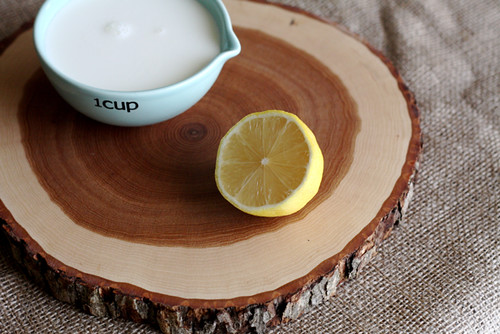
In a 1-cup measuring cup, add 1 Tablespoon of fresh lemon juice. Top the lemon juice with with skim, low fat or whole milk. Stir and let sit for two minutes. After two minutes, your milk is both acidic and curdled. Perfect!
Yogurt and Milk
Mix 3/4 cup plain yogurt with 1/4 cup of milk. Stir and make it a quick substitution for buttermilk.
Milk and Cream of Tartar
Mix 1 cup of milk with 1 3/4 teaspoon cream of tartar. To ensure that the mixture doesn’t get lumpy, mix the cream of tartar with 2 Tablespoons of milk. Once mixed add the rest of the cup of milk. Cream of tartar is an acid and will simulate the acidic environment of buttermilk in a pinch.


251 Responses
Joy, Is substitute butter milk safe for baking and cooking?
hi thank you for these tips, i work as a baker i tried using these but the taste differentiate a lot from when you use buttermilk.
Is it possible to use sour cream to make buttermilk? I know it’s a long shot but I’ve got some sour cream that needs using up
Yes. I would add a squirt of lemon and enough water to make it a buttermilk consistency.
Get some frozen lemon juice to put in your freezer-always handy-Minute maid
can someone please tell me if the ‘buttermilk’ as a side product of whipping cream to form butter the same thing as cultured buttermilk? thank you!
No, it is not the same thing as cultured buttermilk. Cultured buttermilk has cultures added to it
I have recently been enjoying kefir and filmjolk for their health benefits. Can either be used as a buttermilk substitute, or is their makeup not suitable for baking? Thanks!
Thank you so much. This saved me a trip from the store this morning, I was making Red Velvet Pancakes and completely forgot I used it all up a couple of days before..
But what can i use expired fresh cream for? can i use it instead of buttermilk? for scones maybe?
I suppose it depends on how expired the cream is? It’s hard to say. I prefer to use a fresh cream and sour it myself with lemon or vinegar.
Love all the posts. You have saved the day for me. They only carry cultured buttermilk in the winter here